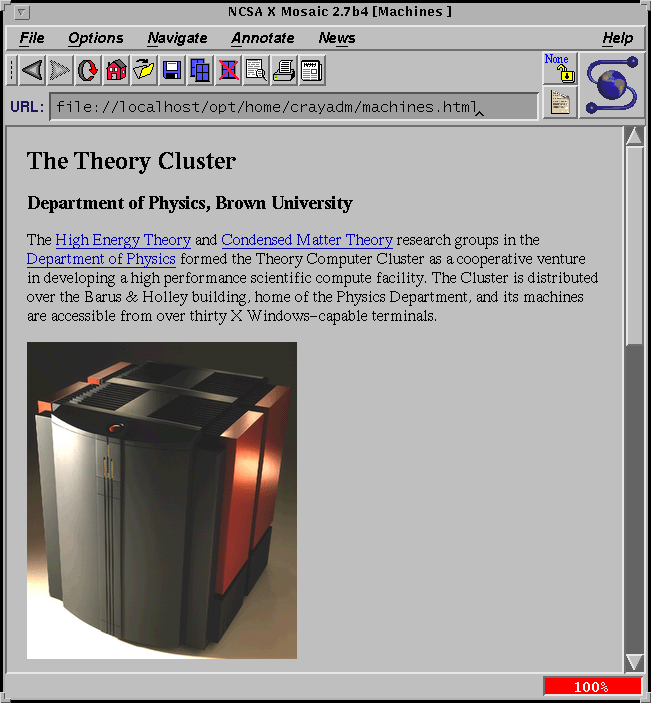
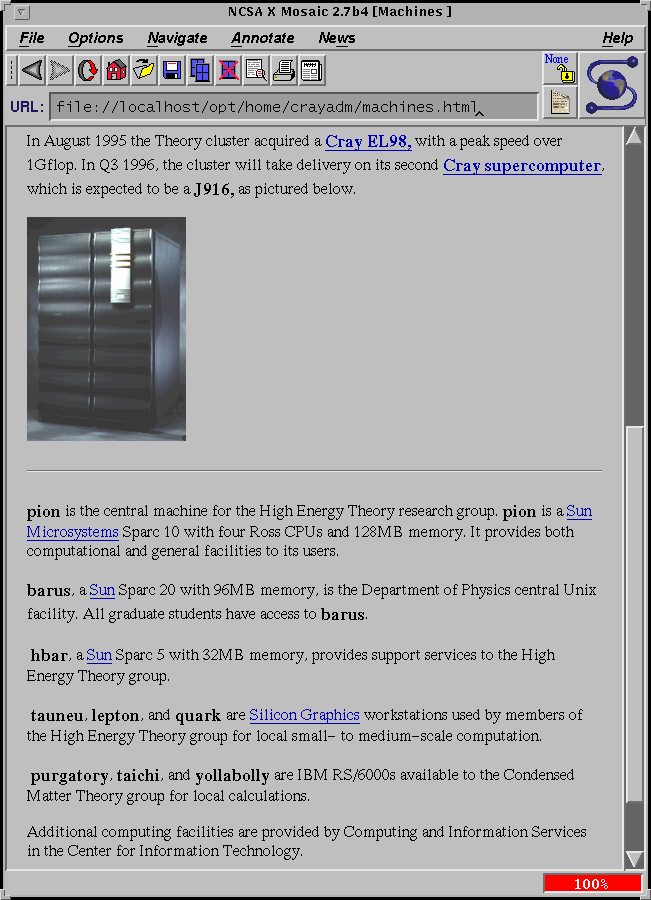
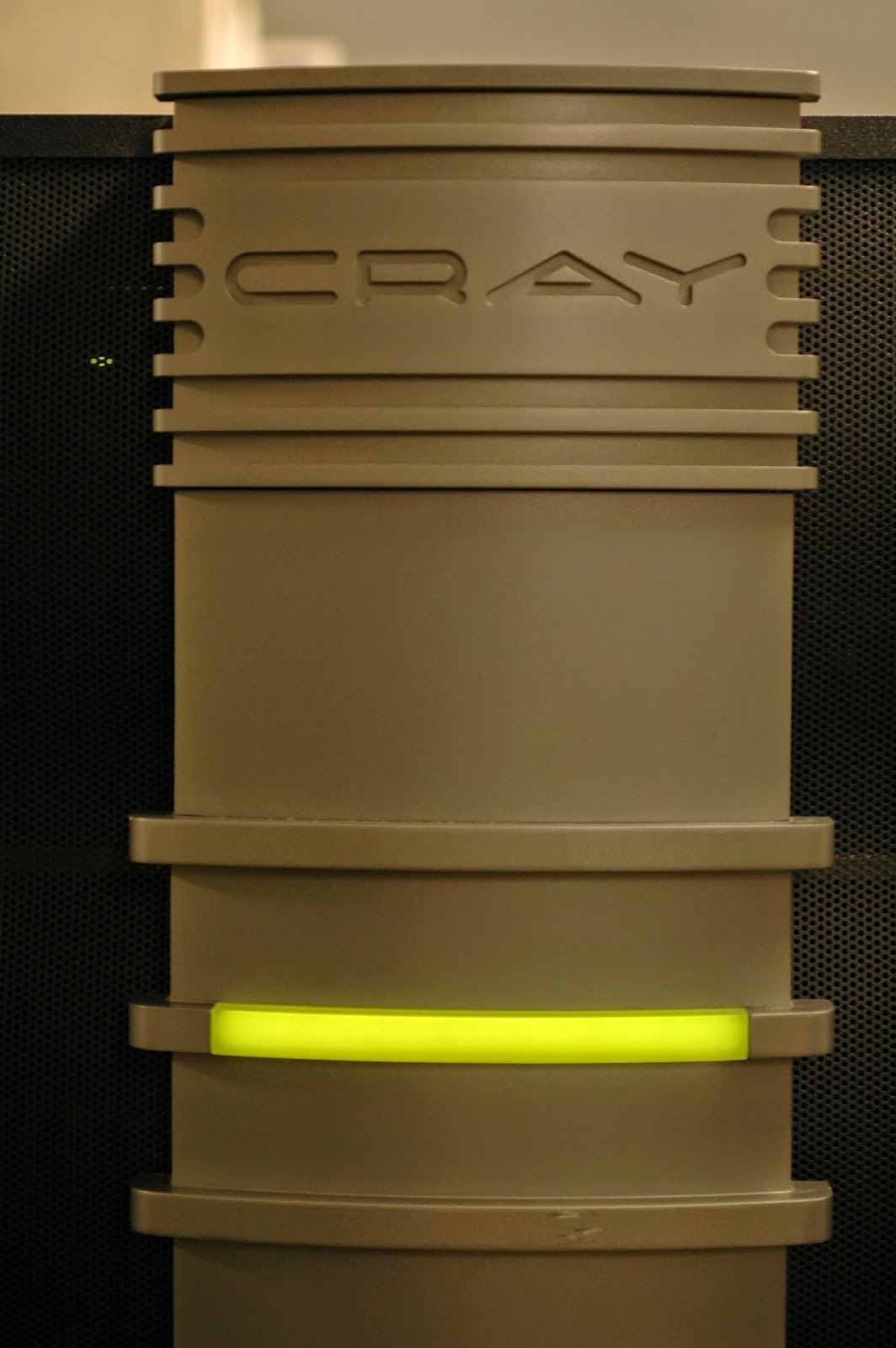
It was about four years ago when I first learned that there was still a Cray in the Department of Physics at Brown University. The machine was in the same building as my office; for years I had no idea it was sitting idle just a few floors above me. My colleague Prof. Ian Dell’Antonio facilitated the donation to the Retro-Computing Society of RI. He uses the high energy theory cluster for research on observational cosmology and gravitational lensing.
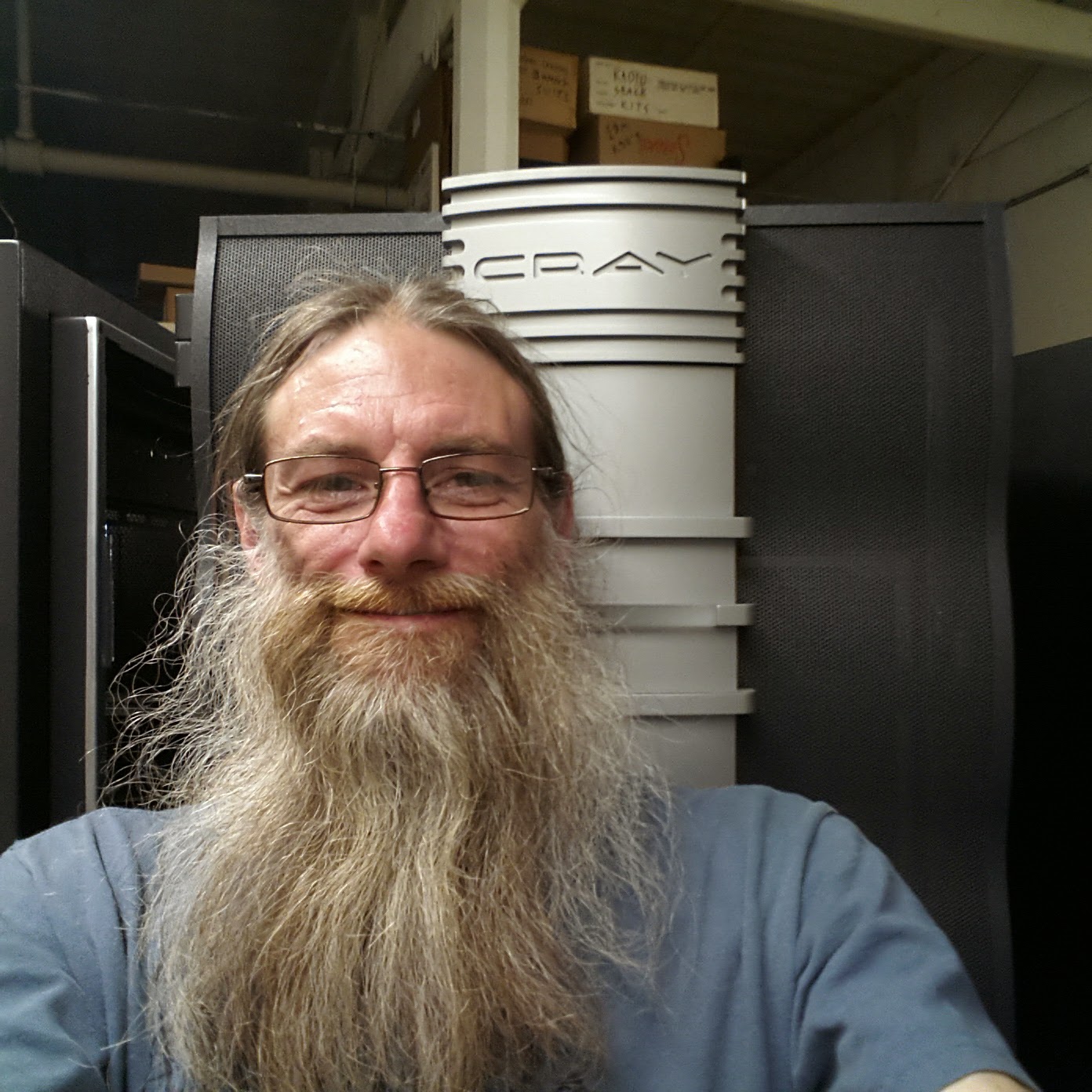 |
| My other computer is a Cray… |
In my previous installment I described the Theory Computing Cluster machine room where the Cray J916 had been used for high energy theoretical physics research at Brown University. It was installed in 1996. I’m not sure exactly when they stopped using it. I was told that it was difficult to program and had been unused for some time. Supercomputers tend to have a rather short shelf life.
We first moved the Cray to Brown’s Science Center where it was on display for a few years. Before it could be safely moved I had to “split” the cabinets. There is one Peripheral Cabinet housing the I/O Subsystem and disk arrays. The second cabinet is the mainframe, or Processing Cabinet, which contains the CPUs and memory. The Cray documentation sometimes uses the archaic definition of mainframe to refer to the primary frame (or cabinet) that contains the central processor. The Oxford English Dictionary cites a usage from Honeywell in 1964 and gives this definition:
mainframe, n.
2. Computing. Originally: the central processing unit and primary memory of a computer. Now usually: any large or general-purpose computer, esp. one supporting numerous peripherals or subordinate computers.
The two cabinet are bolted together when it is installed. There are a number of data and control cables between the two cabinets that I carefully disconnected. Then I removed the AC power entry box in each cabinet to prevent the power cord from getting damaged during the move. A fully configured Peripheral Cabinet could weigh as much as 800 lbs and the Processing Cabinet up to 1,000 lbs. This machine is moderately configured and we estimate that the entire systems weighs more than half a ton. Machines like this were often, and accurately, referred to as big iron.
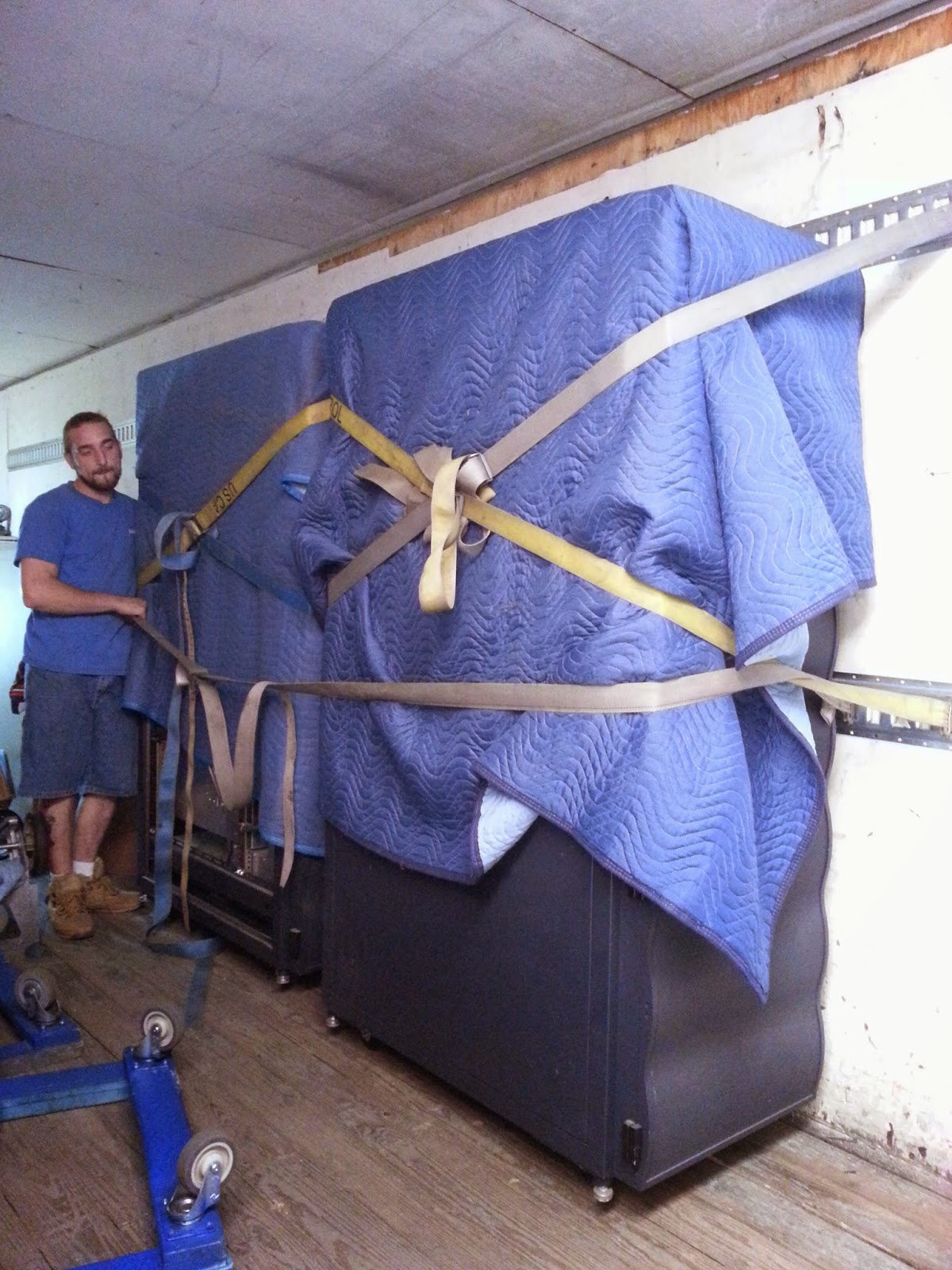 |
| Moving day. Our facility has a loading dock and freight elevator. |
The Cray arrived at our facility on June 23, 2014. We then began to read the fine manuals:
- Preparing for a Cray J916 System Installation
- Hardware Installation Procedures – Cray J916
- Automated Confidence Testing – Cray J90 Series
There was also a form called the Installation Report which the customer was expected to fill out to evaluate the delivery and installation of the system and then send the form back to Cray for quality control. The top of the form has a line that is labeled: Customer Name (if not confidential)
Before we could reassemble the system our next task was to come up with a plan on how we were going to plug it in…
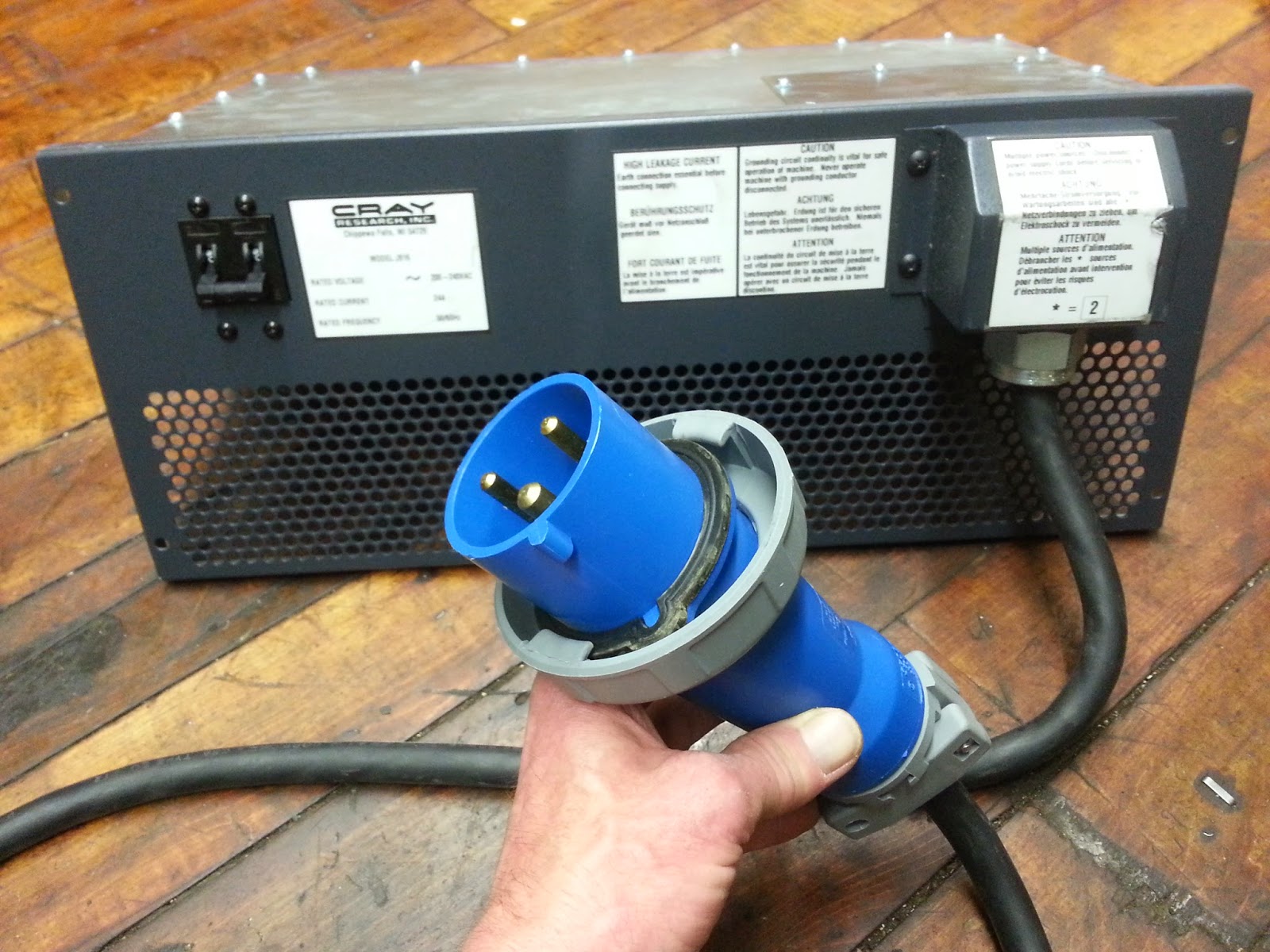 |
| One of the two AC power entry boxes with an IEC 309 industrial plug. The blue color indicates that it is rated for 200-250 Volts. It requires a 30 Amp circuit breaker. |